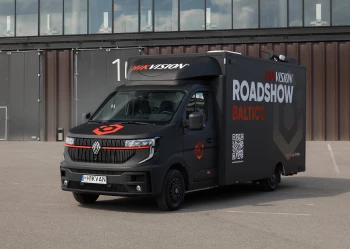
A mobile showroom is an exhibition space built onto a vehicle or trailer which, once parked, unfolds into a fully equipped display area — complete with a raised platform, lighting and brand graphics — allowing you to showcase your product right where your customers are.
At Bannert, we design and build bespoke mobile showrooms: from fit-out and kitting out, through to branding, financing and servicing. We have completed over 1,000 vehicle and trailer fit-outs, and our showrooms are on the road as part of roadshows for manufacturers of installations, heating systems, electrical engineering, joinery and sportswear in Poland and abroad.

What is a mobile showroom?
A mobile showroom is the brand’s portable sales and display space. On the road, it looks like an ordinary vehicle with graphics on it. Once on site, it opens its side wall or hatches, unfolds a platform, steps and an awning — and within a matter of minutes transforms into a small stand, showroom or training room, which customers can enter to touch the product and speak to an advisor.
The difference compared to a trade fair stand is fundamental: a stand simply waits for customers to come into the hall. The mobile showroom comes to the customer itself — for a warehouse, a company’s headquarters, a building site, a town square, a festival or a trade fair. Once built, it lasts for years and can be used for dozens of events, rather than just the three days of a single event.
A car, a trailer, a semi-trailer or a container? Types of mobile showrooms
A mobile showroom can take several forms. The choice depends on how often you change location, how many products you want to display, and who will be driving the vehicle. Bannert builds showrooms on vans, lorries and trailers — these are designs that combine full mobility with quick set-up.
| Form | Driving licence | On-site installation | When to choose |
|---|---|---|---|
| Delivery van up to 3.5 tonnes (e.g. Mercedes Sprinter, MAN TGE, Renault Master, Iveco Daily) | Category B | a dozen or so minutes, without any extra equipment | A roadshow visiting numerous towns and cities, client visits, frequent journeys; organised by a sales representative or adviser |
| Lorry (e.g. Mercedes Actros) | Category C or C1 | a dozen or so to several dozen minutes | A large exhibition area, machinery and equipment, and a training room on board |
| Exhibition trailer (e.g. 3.75 m, 7.30 m, 8.00 m with a swivel drawbar) | B, B96 or B+E — depending on the weight of the combination | a few minutes after unclipping it from the car | Staying in one place for a few days; the towing vehicle is free to carry out other tasks |
| Semi-trailer | Category C+E (tractor unit) | usually a few hours, often with technical support | The biggest exhibitions and European tours |
| A container or a pavilion | — (transport by crane or HDS) | installation, connections, crane | A permanent display lasting weeks or months, e.g. a sales office for a property development |
Who is the mobile showroom aimed at?
A mobile showroom works best when a product needs to be seen, touched or tested, and customers are spread across the country. Our solutions are used in applications such as:
- Plumbing, heating and sanitary facilities — roadshows at wholesalers and meetings with fitters. We have built showrooms for companies including TECE, KAN-therm, Herz, Afriso, Galmet and Ariston.
- Electrical Engineering and Automation — live demonstrations of equipment and systems, training courses for contractors (including Legrand).
- Fasteners, tools, construction — visits to clients and on construction sites (including Marcopol).
- Technical training courses — a mobile training centre with an equipment display, similar to the Galmet showroom, based on a Mercedes Actros.
- Sport, fashion, consumer electronics and telecommunications — product launches and promotional campaigns at events (including Salomon, Haute Route, T-Mobile and AUDAC).
- Institutions, education and finance — a mobile exhibition, bookshop or customer service centre, such as the IPN’s exhibition van or a mobile bank.
- Furniture, interiors, joinery — „showroom-style” displays, e.g. a glass-fronted display car featuring a fitted bedroom.
Bannert mobile showrooms — projects
We design every showroom from scratch to suit the client’s products and way of working. Click on the photo to view the full gallery of our projects.


You can find more projects in the gallery display and event vehicles.
On which vehicles do we build mobile showrooms?
We choose the bodywork based on what needs to fit inside and who will be driving the vehicle. We most commonly work with the following chassis:
- Mercedes Sprinter, MAN TGE, Renault Master, Iveco Daily, Opel Movano — Showroom vehicles up to 3.5 tonnes, which any driver with a Category B licence can drive. The most popular choice for roadshows.
- Lorries, e.g. the Mercedes Actros — when you need a large space, heavy exhibits or a training room on board.
- Exhibition and event trailers — ranging from a compact 3.75-metre trailer with steps, through a 7.30-metre trailer, to an 8.00-metre trailer with a swivel drawbar.
We can build a showroom on a new chassis or on a vehicle you already own — once we’ve checked that it’s suitable for conversion.
The equipment and solutions we use
- Side walls and flaps that open — either on one side or both sides, so that the display is visible from the street.
- Platforms, stairs and handrails — walking into the showroom as if you were entering a living room, not a car.
- Glass walls and display windows — the display is visible even when the unit is closed.
- Awnings and side tents — an additional, covered waiting area in front of the vehicle.
- Furniture and display systems — shelving, counters, display units for products, demonstration stations for setting up equipment.
- LED lighting, screens and sound systems — illuminated displays and multimedia presentations, even after dark.
- Electrical installation and power supply — from the mains, a generator or batteries, depending on where the showroom is to be located.
- Graphics and wrapping — designing and implementing the branding in-house, so that the showroom also acts as an advertisement for the brand whilst on the road.

How a mobile showroom is created — step by step
- Consultation and needs analysis. We decide what is to be displayed, where the showroom will be set up, how many visitors it will accommodate at any one time, and who will drive it.
- Vehicle selection and concept. We offer a choice of chassis or trailer, interior layout and body opening mechanism.
- Design and quotation. We are preparing a design for the fit-out, fittings and graphics, as well as a detailed quotation.
- Production. We are constructing the fit-out at our site in Bytom — the structure, walls, services and display fittings.
- Branding. We produce and apply brand graphics.
- Handover and training. We hand over the fully fitted showroom and show the team how to set it up and dismantle it efficiently.
- Service. We provide repairs under warranty and after the warranty period, as well as upgrades when your product range changes.
If you are planning a route for a specific trade fair season, please contact us well in advance.
How much does a mobile showroom cost?
The price of a mobile showroom depends primarily on five factors:
- base vehicle — a new or second-hand chassis, a vehicle weighing up to 3.5 tonnes, a lorry or a trailer;
- the size and design of the buildings — the number of opening walls, glazed areas, landings and awnings;
- display equipment — furniture, demonstration stands, screens, sound system;
- installation — power supply, lighting, heating or air conditioning;
- the field of graphic design — from a logo to a full vehicle wrap.
We’ll draw up a detailed quote following a brief discussion of your requirements — usually, a description of the products you wish to showcase and your planned itinerary is sufficient.
When comparing costs, it is worth bearing in mind that a showroom is an investment for years to come. A single vehicle is used at dozens of events each season, and in between these events, it acts as a moving advertisement for the brand. We discuss this in more detail in the article A mobile showroom or a trade fair stand — which is better value for money?.
Purchase, lease or loan
You can finance your mobile showroom with cash, a loan or a lease – we’ll help you choose the right financing option to suit your marketing budget. You’ll find more details on the website funding.
Why Bannert?
- We are a manufacturer, not a middleman — the design, construction, fittings and graphics are all produced in one place, in Bytom.
- Over 1,000 vehicle and trailer bodywork projects and over a dozen years’ experience in bodywork construction.
- Showrooms for brands that go on tour every season — including TECE, Legrand, Marcopol, KAN-therm, Galmet, Ariston and Salomon.
- After-sales service — repairs under warranty and after the warranty period, as well as modifications to accommodate new products.
- Projects in Poland and abroad — We have also built showrooms for foreign companies.
Frequently asked questions about the mobile showroom
How does a mobile showroom differ from an event car?
It is often the same type of vehicle, but with a different purpose. Event car It is mainly used to attract attention at events. A mobile showroom is a sales tool: it features a full product display, an area for talking to customers and often stations for demonstrations or training sessions.
What sort of driving licence do you need to run a mobile showroom?
You can run a mobile showroom using a van with a maximum authorised mass of up to 3.5 tonnes with a Category B driving licence. Heavier vehicles require a Category C1 or C licence. When towing a trailer, the weight of the entire combination is the deciding factor — a Category B or B96 licence may suffice, or a Category B+E licence may be required. When selecting a vehicle, we immediately take into account who will be driving it.
How long does it take to set up the showroom on site?
In the showroom, whether on a car or a trailer, all you need to do is open the side panels or hatches, unfold the platform, steps and awning, and connect the power supply. This usually takes a dozen or so minutes and can be done by 1–2 people, without the need for a forklift or any additional equipment.
How long does it take to build a mobile showroom?
The timeframe depends on the availability of the chassis and the complexity of the bodywork, so it is worth planning your route for the trade fair season well in advance.
Can you fit out the car we already have?
Yes, provided the chassis is suitable for bodywork in terms of load capacity and technical condition. We will assess this before drawing up the design. We can also select and supply a new chassis.
Can a mobile showroom also serve as a training room or an office?
Yes. We have built showrooms that combine exhibition spaces with mobile training centres, as well as mobile offices and customer service centres. We design the interior layout to suit the team’s specific tasks.
Do you build mobile showrooms for companies from abroad?
Yes. We carry out fit-out projects for clients from Poland and abroad. We speak Polish, English and German.
Is a mobile showroom the same as a mobile exhibition hall?
Yes — „mobile showroom”, „mobile show room”, „mobile exhibition space”, „exhibition car” or „display vehicle” are all different names for the same concept: a portable space in which a brand showcases its products to customers in the field.
Plan your mobile showroom
Let us know what you want to display and where the showroom will be travelling to. We’ll suggest a vehicle and a layout, and prepare a quote for you.