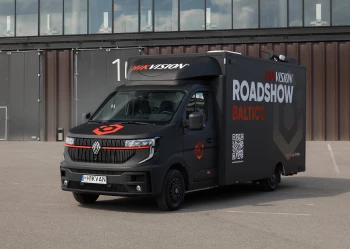
For years, the traditional exhibition stand was the obvious choice for companies wishing to showcase themselves at trade events. Booking a stand, designing the layout, setting it up, preparing the graphics, a few days of talking to visitors, and that’s it. This model still works, but it is increasingly seen as a relic of a bygone era of marketing.
These days, a brand shouldn’t wait for customers to turn up at a trade fair. Instead, it should be able to reach customers where decisions are actually made: at the company’s headquarters, out in the field, at a local event, during a roadshow, a product launch or a face-to-face sales presentation.
That is precisely why a mobile showroom is no longer just an interesting alternative to a trade fair stand. For many companies, it is becoming a far more cost-effective, flexible and forward-looking sales tool.
A traditional trade fair stand: an expensive way to exhibit on someone else’s terms
A traditional trade fair stand has one major drawback: it is heavily dependent on the venue, the date and the rules imposed by the event organiser. The company turns up wherever the trade fair is being held, pays for the space, complies with the venue’s regulations and, for several days, competes for attention amongst dozens or hundreds of other exhibitors.
At first glance, it may seem like a simple and tried-and-tested model. In practice, however, it very often turns out that a trade fair stand incurs significantly higher costs than the initial quote suggests.
Companies usually quote for the design and construction of the fit-out. They are less likely to analyse in detail the costs that arise later:
- transport of items to every event,
- set-up and dismantling at every event,
- storage of structures between events,
- maintenance, corrections and updates to graphics,
- tailoring the fit-out to the requirements of a specific hall,
- fees for exhibition space,
- additional technical costs imposed by the organiser,
- a limited duration of exposure, usually only for a few days.
This is where the problem begins. A traditional exhibition stand often looks like a one-off marketing expense, but in practice it can turn into a bottomless pit. You pay for a presence in a specific location, at a specific time, and for a very short period. Once the event is over, some of the stand components end up in storage, some require modifications, and some simply become outdated.
When might a traditional stand be a good idea?
To be fair, it’s worth making it clear that a traditional trade fair stand isn’t always a bad choice. It can be a good option when a company wants to attend one specific event a year, has no plans for any outreach activities, and is solely interested in having a presence in the exhibition hall.
If the aim is simply to „be present at the trade fair” on a one-off basis, to capitalise on the existing footfall and wrap things up after a few days, a standard stand may suffice.
But that is precisely its limitation. The stand is mainly operational whilst the event is taking place. A mobile showroom can operate for much longer.
Mobile showroom: your own sales space that goes wherever your customers are
A mobile showroom completely changes the way we think about brand presentation. It is not just a space rented for a few days. It is your own sales and marketing tool that can be used time and time again, in different locations and in different scenarios.
Such a vehicle may appear at a trade fair, but its work does not end when the hall gates close. It can carry on to customers, business partners, distributors, showrooms, dealerships, local events, product launches, promotional campaigns or roadshows across several cities.
That’s a huge difference. Instead of paying for a short-term presence in one location, the company is creating a mobile space that can operate all year round.
The biggest advantage: a longer investment lifespan
When comparing a trade fair stand and a mobile showroom, you mustn’t focus solely on the initial cost. That’s the most common mistake.
A traditional stand may seem cheaper at first, but its real effectiveness wears off very quickly. After a few days at the trade fair, it has to be dismantled, transported, stored and often set up all over again for the next event.
A mobile showroom works differently. It is designed to be a reusable tool. It can be used for trade fairs, roadshows, sales meetings, local sales campaigns, product launches and branding initiatives. A single investment can be used in many different locations, rather than being tied to a single venue and a single date.
This is where the real value for money begins. The more on-the-ground activities a brand plans, the more sense it makes to have its own mobile exhibition space.
Fewer restrictions, more control over the customer experience
At traditional trade fairs, a brand is always operating amidst competition. Customers move from stand to stand, make comparisons, get distracted, look at one display after another, and often there isn’t the right setting for a quiet conversation.
A mobile showroom offers a completely different experience. Customers enter a space designed specifically for the brand, the product and the way conversations are conducted. Care can be taken with the interior layout, product display, lighting, presentation area, meeting space, multimedia facilities and the comfort of the sales team.
This isn’t just any old space in a hall. It’s a controlled sales environment.
As a result, the mobile showroom works particularly well in situations where the product is needed:
- demonstrate in practice,
- discuss with the client,
- compare with other solutions,
- to present in a suitable setting,
- link it to a specific brand experience,
- to showcase it outside the usual exhibition space.
In many industries, simply being present at a trade fair is not enough. Customers need personal contact, demonstrations, conversations and an environment in which they can truly understand what’s on offer. A mobile showroom provides much more scope for this.
A traditional stand comes to an end once the event is over. A mobile showroom carries on
This is one of the most important comparisons.
A trade fair stand is usually in use for a few days. After the event, it is dismantled, packed up and taken back to the warehouse. Even if it can be reused, the company still has to adapt to different venues, technical requirements and the organisers’ timetables.
A mobile showroom does not lose its value after an event. It can head straight to the next meeting, to another city or directly to a client. There’s no need to wait for the next trade fair. There’s no need to limit your activities to venues where someone has organised an industry event.
It is the company that decides where and when to showcase its products and services.
The mobile showroom as a sales tool, not just a marketing tool
Many companies view events primarily through the prism of brand image. A stand should look good, attract attention and demonstrate that the brand is active in the industry. This is important, but these days it is often not enough.
A mobile showroom can be more than just a means of promoting a brand’s image. It can become a practical tool for the sales department.
It can be used for:
- product presentations to key clients,
- meetings with distributors,
- product training courses,
- presentations for business partners,
- launch of the new collections,
- door-to-door sales campaigns,
- local promotional campaigns,
- support from a dealer or franchise network.
This means that the investment is not confined to the marketing department. It can directly support sales, customer relations and the development of the distribution network.
Which is actually better value for money?
If a company only compares the cost of building a stand with the cost of setting up a mobile showroom, it is only seeing part of the picture. The real question is this: how many times will this investment be used, and in how many situations will it help the brand reach its customers?
A traditional stand is the cost of attending a particular event.
A mobile showroom is a tool that can be used repeatedly, in many different locations and in various formats.
In practice, the difference is simple. An exhibition stand allows you to showcase your brand where the trade fair is being held. A mobile showroom allows you to take your brand to where your customers are.
For which companies does a mobile showroom make the most sense?
A mobile showroom is particularly well suited to companies that do not wish to limit their activities to a single trade fair. It is a solution for brands that think beyond a standard event presence.
It makes the most sense when a company:
- is planning activities in several towns,
- wants to organise a roadshow,
- needs its own space to display products,
- wants to break free from the trade fair calendar,
- wants to have more control over the circumstances of meetings with clients,
- I need a tool that will last for a few seasons,
- wants to make better use of the events budget,
- is looking for a solution that combines marketing, sales and product presentation.
In such situations, a mobile showroom ceases to be merely a supplement to marketing activities. It becomes one of the most important tools for direct contact with the market.
See what a mobile showroom might look like in practice
Theory is one thing, but with projects like these, the most important thing is to see the actual possibilities for the layout. A mobile showroom can vary in layout, size and character, depending on the sector, the product and the way the sales team works.
It can serve as an exhibition space, an event vehicle, a mobile presentation point, a roadshow vehicle, or a specialised fit-out designed for a specific sales process. That is precisely why every project should be planned not on the basis of a ready-made template, but by asking: what does the brand want to show, to whom, and under what conditions?
Examples of such projects can be seen in our gallery of specialist, event and exhibition vehicles, as well as showrooms:
See examples of BANNERT’s mobile showrooms and specialised vehicles
This is a good place to see the different forms a brand’s mobile space can take and how far one can stray from the traditional way of thinking about a trade fair stand.
Summary: a stand means visibility; a mobile showroom means a competitive edge
A traditional trade fair stand may be sufficient if a company wishes to attend a single event and has no plans for further activities in the field. In such a case, it will fulfil its purpose: it will enable the company to make its presence felt and handle the footfall during the event.
However, if a brand is thinking long-term, wants to make better use of its budget, reach customers in different locations and create its own display conditions, a mobile showroom is a far more forward-looking choice.
This isn’t just a vehicle with a body. It’s a mobile retail space that can operate all year round, support the sales team, strengthen the brand and offer customers an experience that a traditional trade fair stand is usually unable to provide.
That is why more and more companies are moving away from asking whether it is worth attending trade fairs. Instead, they are starting to ask how they can bring their brand directly to their customers.
And it is precisely to this question that the mobile showroom provides one of the best answers.